Recent Efforts and Ongoing Challenges
Since Summer 2025, in an effort to begin rebuilding a Canadian flux network, 174 historic and active flux sites have been identified across the country, representing at least 9 different ecosystems.
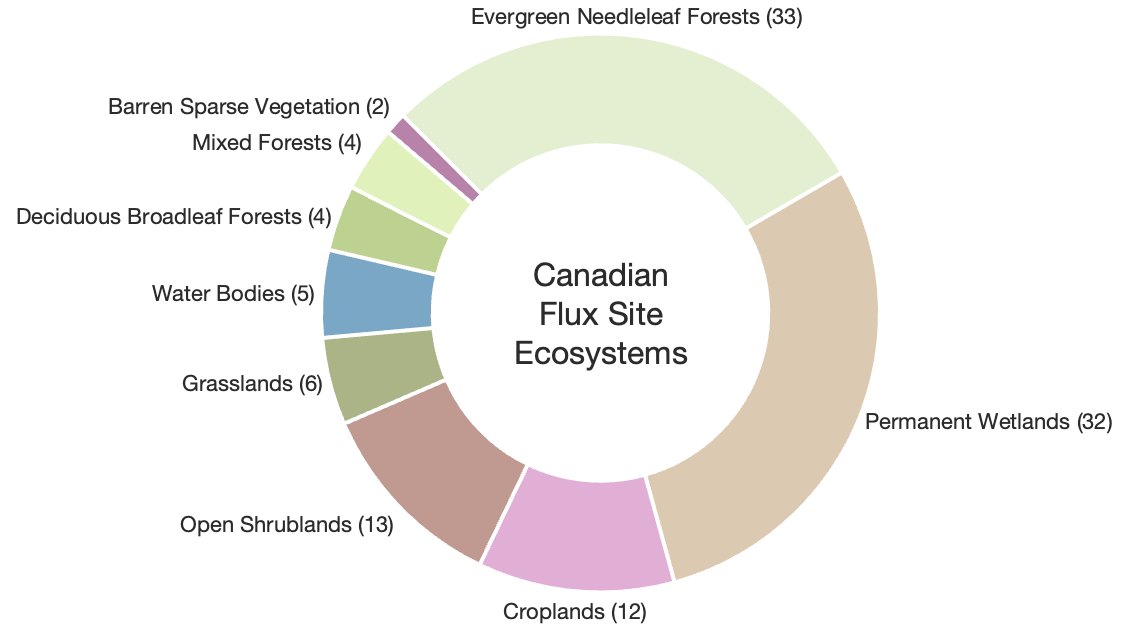
Although new regional and domain-specific initiatives - such as CARBONIQUE in Quebec, CanN2Onet for nitrous oxide fluxes, Can-Peat for peatland carbon cycling, and Wetlands as Natural Climate Solutions Network for freshwater mineral soil wetlands - are advancing important components of this national picture, Canada still lacks a coordinated, pan-Canadian flux network to represent and conserve this valuable resource.
All the sites are maintained primarily through individual research programs, each relying on heterogeneous instrumentation, metadata standards, and data-processing pipelines. Long-running time series remain vulnerable to loss due to precarious funding, limited technical capacity, and the absence of a national framework to support long-term data stewardship and interoperability.
Because flux sites across Canada currently operate with disparate instrumentation, uneven ecosystem representation, and limited long-term data support, producing integrated, policy-relevant assessments of terrestrial and aquatic GHG, water, and energy fluxes remains challenging. Many principal investigators are willing to share their data; nearly 70 sites already have data stored in Ameriflux, totalling 535 site-years of flux data representing the period 1994–2024.
However, a lack of coordinated infrastructure, time, and technical capacity means that fewer than half of Canadian flux tower sites provide open, standardized datasets, leaving valuable time series inaccessible for synthesis or model integration. Additionally, as international data relationships continue to evolve, maintaining robust Canadian sovereignty and stewardship of climate data remains essential for national planning and collaboration.